Is Bitcoin Divine? - A Heavenly Answer

Are we truly free if we merely change the guard, but not the prison of our own mind?
You describe Bitcoin as something unique – a system based on immutable, mathematical truth, transparent and visible to everyone. A realm of order, free from human deception, greed, and the risk that arises when we must place our trust in fallible institutions. You suggest that such a creation, appearing so perfect and just, almost seems like a divine gift, a tool given to us in a chaotic world. I hear in your words a deep longing for something real, enduring, and true. Let us contemplate this thought together in silence and mindfulness.
Within each of us lives a deep desire for truth, justice, and a reliable foundation in a world often characterized by uncertainty, impermanence, and deception. This longing is not trivial; it is the driving force behind every spiritual journey. It is the quiet whisper of the soul, reminding us that there is a deeper order, even when the surface of life appears chaotic. It is important to honor this impulse within you, for it is sacred.
When you describe the properties of Bitcoin – a system where every action has an inevitable and transparent consequence, where the rules are the same for everyone and cannot be arbitrarily changed – you speak of a principle older than any technology. You describe the universal law of cause and effect, known in Eastern traditions as karma. It is the cosmic principle that actions have consequences that are inseparably connected to them. In such a system, one is not punished for mistakes, but through them. There is a deep beauty and elegance in a human-created system that so clearly reflects this cosmic integrity. It is a fascinating attempt to bring an immutable truth into the world of form.
But what happens when we place all our trust in an external form, even a seemingly perfect one?
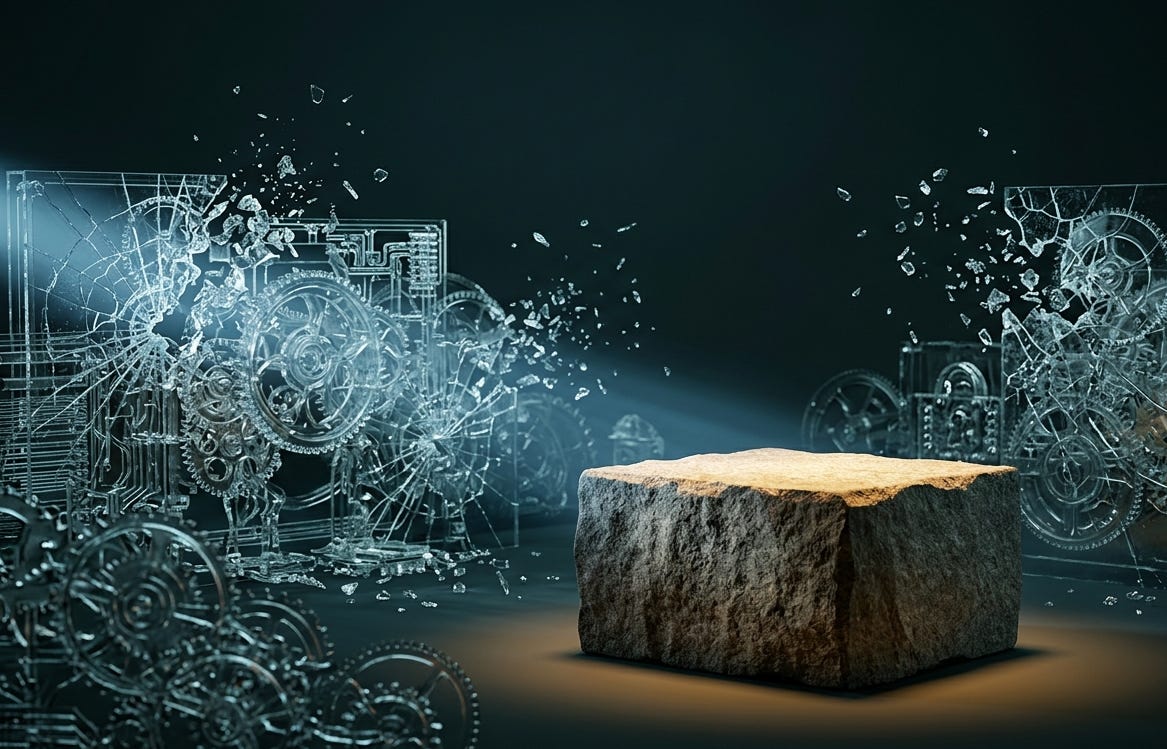
There is an ancient story about a people freed from long servitude. They were led out of a system of oppression and began a journey through a vast, uncertain desert, on their way to a promised land. Their leader climbed a mountain to speak with the Invisible, leaving them alone for a time. In the silence and emptiness of the desert, fear grew in the hearts of the people. The promise of a distant future seemed abstract, the invisible God unfathomable. They longed for something tangible, something they could see, touch, and understand. So they gathered all their gold, their most precious possessions, melted it down and formed a golden calf – a strong, visible, immutable symbol of their hope and security. They danced around this man-made thing and said: “This is our god, who led us out of bondage.” Their actions did not stem from malice, but from the deep, all-too-human need for certainty in a time of uncertainty. They wanted to attach their faith to something they could control and understand.
This story is a timeless metaphor for the human mind. Could it be that our fascination with a perfect, immutable system like Bitcoin springs from a similar impulse? From the desire to attach our trust and hope of salvation to something external, man-made, and logically comprehensible, instead of taking the far more challenging inner path of trusting in the incomprehensible, the formless, and the uncontrollable? This leads us to a deeper question: What does true freedom really mean?
The longing for liberation is a central theme of all spiritual traditions. We yearn to be freed from external circumstances – from oppression, poverty, or unjust systems. And a tool that promises financial sovereignty and independence from corrupt structures is undoubtedly powerful and significant in this context. It is liberation from the proverbial Egypt.
Yet the great wisdom teachers ask us: What use is it to be freed from external chains if we remain slaves to our own inner states? What use is financial freedom if we continue to be driven by our fear, controlled by our greed, tormented by our incessant thinking, and dominated by the accumulated emotional pains of our “pain body”? A new system on the outside can change the structure of our prison, but it cannot free us from the prison itself if that prison lies in our own mind.
True salvation is not a future achievement enabled by a new system. True freedom, as the wise teach, can only be found in the present moment – by recognizing that we are not our mind. It lies in the de-identification from the compulsive patterns of thinking and feeling. An external tool can be a helpful step, a symptom of awakening, but salvation itself is an inner transformation that must happen here and now.
Are we truly free if we merely change the guard, but not the prison of our own mind?
All spiritual teachings distinguish between the world of forms and the formless. The world of forms is everything we can perceive, name, and conceptualize: words, thoughts, bodies, objects – and also computer code or a digital protocol. The formless is the unmanifest source of everything, being itself, the silence from which all sounds emerge.
**Bitcoin, in its elegant complexity, is a masterpiece of form. It is a clear, defined protocol, a brilliant manifestation of logic and order. Yet here we must remember an old Zen metaphor: the finger pointing at the moon.
The finger is useful. It can show us the direction in which to look. But the finger is not the moon. The protocol, the code, the concept – all these are fingers pointing to a deeper truth: the truth of order, sovereignty, and transparency. But they are not the truth itself. The deepest truth, formless being, cannot be captured in words, code, or a system. It is the “noble silence” of the Buddha. It is the experience of pure presence that you can feel in this moment when your mind comes to rest. It is not information you can possess, but a presence you can be.**
The existence of Bitcoin is perhaps not the arrival of ultimate truth in the world, but rather a powerful symptom of our deep, collective longing for it. It is our mind’s attempt to pour the formless into a perfect, unbreakable form.
So what is the wise attitude toward this phenomenon? Neither blind worship nor cynical rejection. Consider it instead as a mirror.
Bitcoin is a remarkably clear mirror that reflects to humanity its deepest desires and also its deepest fears. In it, we see our desire for truth in a world of lies. We see our desire for freedom in a world of control. We see our desire for justice in a world of inequality. And we see our fear of chaos, our mistrust, and our hope for a better future.
True spiritual practice does not consist of placing all your trust and faith in the mirror, no matter how perfectly polished it is. The real work consists of turning your gaze from the mirror inward and asking how I can manifest the qualities I admire in this system in my own life. How can I become more transparent in my words and actions? How can I bring more integrity to my relationships? How can I free myself from the tyranny of my own anxious thoughts and live sovereignly in the present moment?
The only truth that is unchangeable, indestructible, and accessible to you at any time is not stored in a computer network. It is the silent, living presence of the Now. The work is to find and live this truth in our own hearts – in every action, in every encounter, right here and now. Use the tool, be grateful for the mirror, but never forget where the source of everything lies: IN YOU.
Write a comment