OpenAI to Adopt C2PA Standard and Google's SynthID for AI Content Labeling
OpenAI to Adopt C2PA Standard and Google’s SynthID for AI Content Labeling OpenAI is moving to visibly and invisibly label its AI output, betting that technical standards can keep pace with increasingly convincing fakes. The shift comes as big tech companies race to prove they can police the very tools they are unleashing.
Early push on provenance (2024–May 2026)
OpenAI has been working on content provenance since at least 2024, when it began adding Content Credentials to images from DALL·E 3, ImageGen and Sora and joined the steering committee of the Coalition for Content Provenance and Authenticity (C2PA). C2PA uses cryptographically signed metadata to record how a piece of media was created or edited, giving journalists and platforms context about “whether it is what it claims to be.”
On May 14, 2026, OpenAI detailed the next phase: a “multi-layered, ecosystem-driven model” that combines C2PA-conformant metadata with Google’s SynthID invisible watermarking and a public verification tool for OpenAI‑generated images. The company argues that “watermarking can be more durable through transformations like screenshots, while metadata can provide more information than a watermark alone,” and that together they make provenance “more resilient than either layer would be on its own.”
Google’s parallel expansion
At Google I/O on May 19, 2026, Google announced it was bringing SynthID and C2PA checks directly into Search, Lens and Chrome so users can ask if an image is AI-generated from within the browser. This unified interface means people “can now check for both provenance systems from a single interface instead of jumping between Gemini and dedicated C2PA checker portals.”
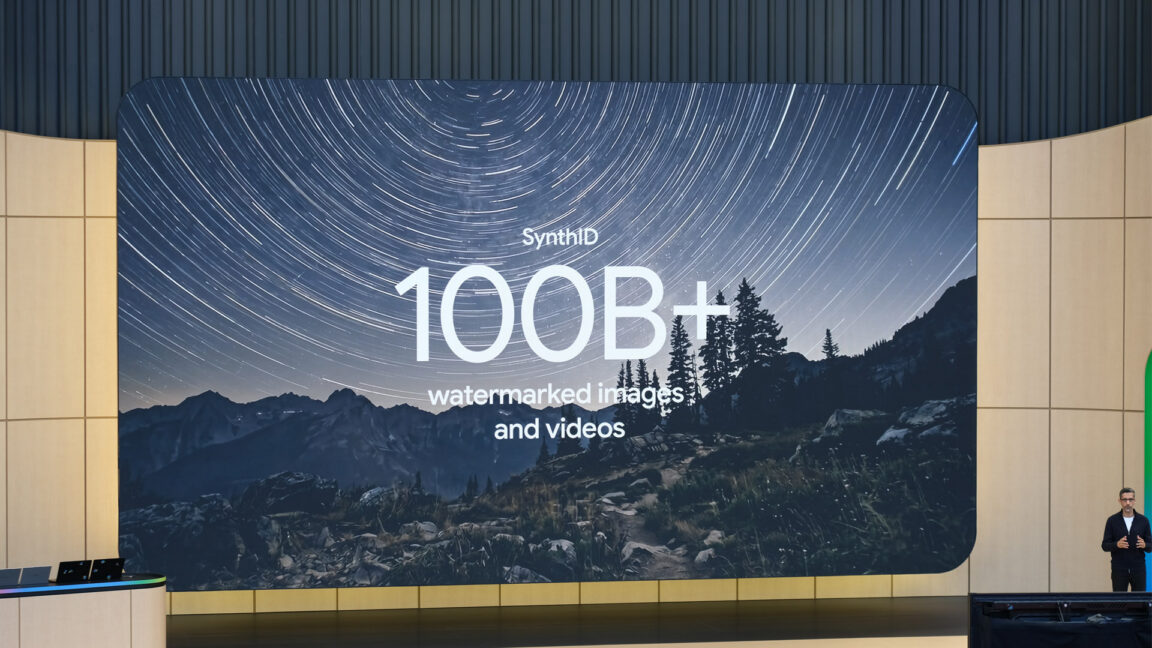
Google has already used SynthID to label billions of images, videos and years’ worth of audio, while also embedding C2PA metadata in Pixel phone photos and, soon, videos.
OpenAI’s May 19 rollout and industry stakes
Also on May 19, OpenAI said images from ChatGPT, Codex and its API will now carry both C2PA credentials and SynthID watermarks, backed by a public portal to check if an image was generated by its models. Tech coverage framed the moment as “make or break time for AI labeling systems,” arguing the combined expansion of SynthID and C2PA is the best test yet of whether such tags can “turn the tide against unlabeled AI fakery.”
Industry watchers note limits: the protections currently apply only to content from major players like Google and OpenAI, not from “less reputable AI tools,” even as other firms such as Nvidia begin adopting SynthID as well. OpenAI itself concedes “no detection method is foolproof,” promising a cautious approach in ambiguous cases.
From OpenAI’s perspective, the move is about “building trust online” through interoperable standards. Human commentators see both promise and risk: if platforms and model providers don’t converge on these systems at scale, the window to make AI labeling work may be closing.
[1] OpenAI – Advancing content provenance for a safer, more transparent AI ecosystem – “we’re strengthening our approach to content provenance with a multi-layered, ecosystem-driven model … giving platforms a trusted way to read, preserve, and pass along the provenance information we attach to our content.”
[2] TechCrunch – OpenAI is making it easier to check if an image was made by their models – “Watermarking can be more durable through transformations like screenshots, while metadata can provide more information than a watermark alone… Together, they make provenance more resilient than either layer would be on its own.”
[3] The Verge – Google is trying to make deepfake detection more accessible for everyone – Google is integrating SynthID and C2PA into Search, Lens, Gemini and Chrome so users can ask, “Is this made with AI?” directly in the interface.
[4] Ars Technica – Google’s SynthID AI watermarking tech is being adopted by OpenAI, Nvidia, and more – Google says SynthID has labeled 100 billion images and videos plus extensive audio, while C2PA metadata is being rolled out across Pixel phones and Gemini.
[5] The Verge – OpenAI Says It’s Getting Serious About AI Detection and Labeling – Images from ChatGPT, Codex and the OpenAI API will carry C2PA credentials and SynthID watermarks, with a public portal to check for these signals, though “no detection method is foolproof.”
[6] The Verge – It’s Make or Break Time for AI Labeling Systems – The expansion of SynthID and C2PA is described as “the opportunity to turn the tide against unlabeled AI fakery that’s deceiving people online,” but only if the whole ecosystem gets onboard.
[7] @gdb on X – Greg Brockman highlighted “SynthID for checking if an image was generated by OpenAI,” amplifying OpenAI’s announcement that images now contain both C2PA Content Credentials and a SynthID watermark and can be identified via a public verification tool.
Continue reading https://foxvector.com
Write a comment