Google and OpenAI Expand AI-Generated Content Labeling with SynthID and C2PA
- Early moves: OpenAI’s provenance push
- Google scales up SynthID and C2PA
- OpenAI and industry adoption
- Make-or-break moment — and remaining doubts
Google and OpenAI Expand AI-Generated Content Labeling with SynthID and C2PA Google and OpenAI are racing to keep up with a flood of ever-more-convincing deepfakes, betting that new labels and invisible watermarks can restore trust in online images before public confidence erodes further.
Early moves: OpenAI’s provenance push
On May 14, OpenAI laid out a “multi-layered, ecosystem-driven model” for content provenance, built around the C2PA open standard for cryptographically signed metadata and Google’s SynthID invisible watermarking. The company framed provenance signals as a way to give people reliable context about “where content came from, how it was created or edited, and whether it is what it claims to be.”
This effort built on earlier steps to add Content Credentials to images from DALL·E 3, ImageGen and Sora, and to make OpenAI a C2PA “Conforming Generator Product,” giving platforms a trusted way to read and preserve that metadata.
Google scales up SynthID and C2PA
At its I/O conference on May 19, Google announced it was “trying to make deepfake detection more accessible for everyone” by bringing SynthID and C2PA checks directly into Search, Lens, AI Mode, Circle to Search and, soon, Chrome. Users will be able to select or circle an image and ask in a side panel, “Is this made with AI?”
Google also committed to broader C2PA adoption across Pixel devices, extending content credentials from photos on Pixel 10 to videos on Pixel 8, 9 and 10, and adding C2PA scanning to Gemini, Chrome and Search.
OpenAI and industry adoption
The same day, OpenAI said images generated by ChatGPT, Codex and its API will now carry SynthID watermarks alongside C2PA credentials, calling the combination a “multi-layered approach” where “these two systems reinforce each other.” TechCrunch reported that OpenAI will also preview a public tool that checks for both signals to see whether an image was generated by its models.
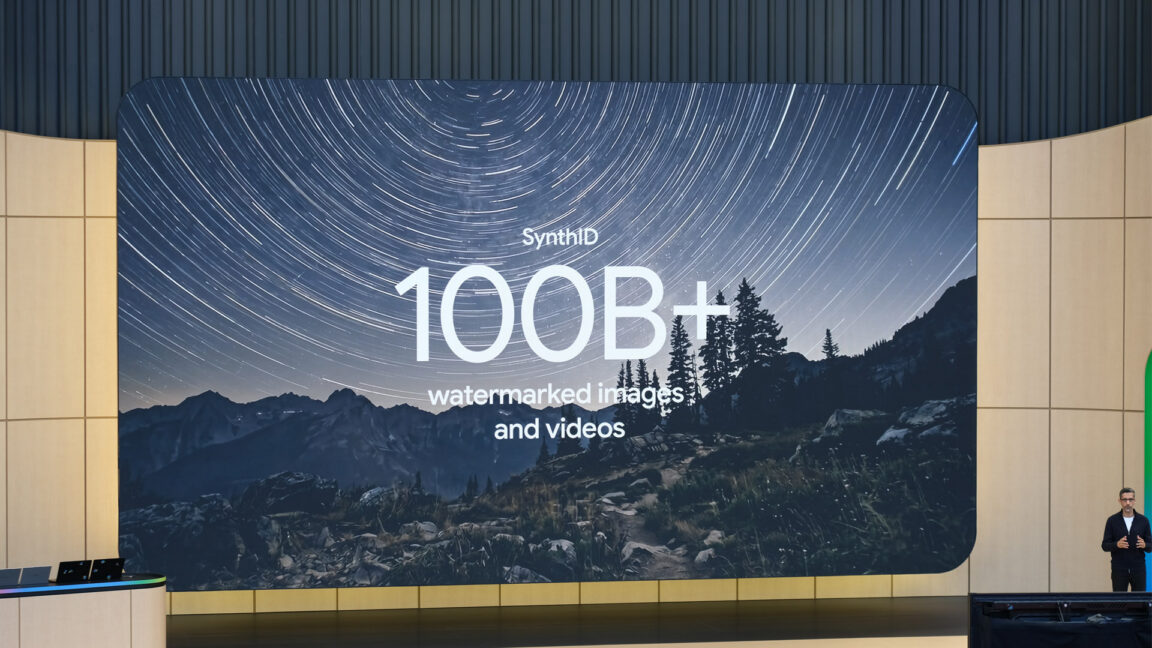
SynthID itself is expanding beyond Google. Ars Technica noted that the watermark has already labeled “100 billion images and videos” plus “60,000 years’ worth of audio,” and is now being adopted by firms including OpenAI and Nvidia. Google DeepMind’s Pushmeet Kohli emphasized the team worked to make SynthID “much harder to remove,” even under compression, cropping or rotation.
OpenAI co-founder Greg Brockman highlighted the shift on X with a succinct summary: “SynthID for checking if an image was generated by OpenAI,” amplifying OpenAI’s claim that images will carry both C2PA credentials and a SynthID watermark, verifiable through a public tool.
Make-or-break moment — and remaining doubts
Commentators describe this as “make or break time for AI labeling systems,” arguing that success hinges on near-universal adoption by model providers and major platforms so that verification becomes a default part of web browsing. Browser-level tools could also work around sites that ignore provenance metadata.
Yet both OpenAI and outside analysts stress that no solution is foolproof. C2PA metadata can be stripped or altered, and SynthID is expected to face continuous attacks from adversaries trying to erase or forge signals. For now, the emerging consensus among both companies and standards advocates is that layered, widely deployed labeling is the best shot at making AI content easier to spot — before it becomes impossible to trust what people see online.
Continue reading https://foxvector.com
Write a comment