Archivist Note: The Bitcoin Chronicles - 1.F.2.2 - The State of the Solar System (Late 23rd Century)
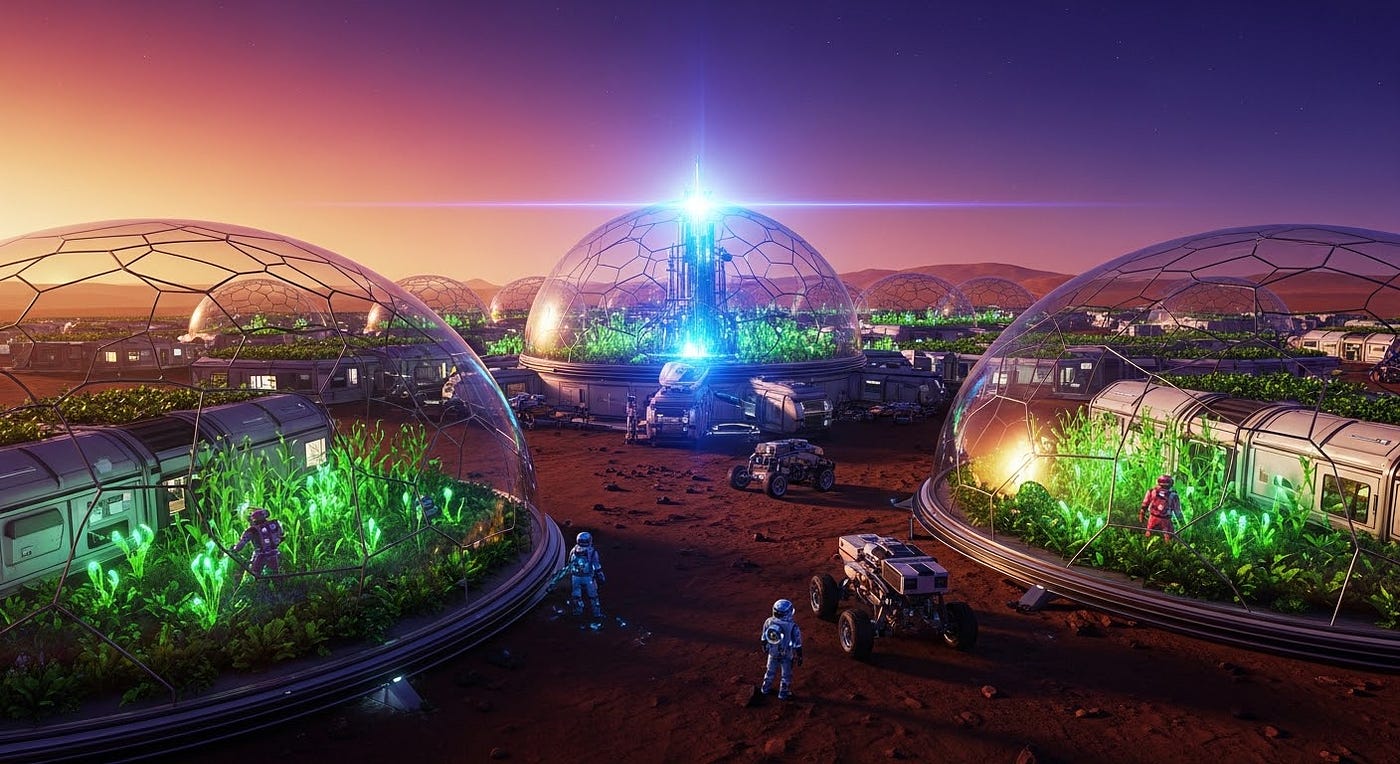
Andrew G. Stanton - Dec. 23, 2025
Designation: 1.F.2.2
Author: Office of Interplanetary Historical Records
Date Range Covered: Late 23rd century (circa 2280s)
By the late 23rd century, the human presence within the Solar System can no longer be accurately described as experimental, provisional, or frontier-based.
After several centuries of continuous habitation, iteration, and local adaptation, the primary off-Earth enclaves of the Solar System have become pleasant, thriving places to live.
This condition did not arise suddenly, nor was it the result of a single technological breakthrough. It emerged gradually as survival problems gave way to maintenance, stewardship, and cultural maturation.
Earth
Earth remains densely populated, institutionally complex, and governed through fiat-based monetary systems. Redenomination cycles have preserved usability and continuity, though long-term decay and boom–bust dynamics persist. Earth governance is largely confined to Earth itself.
The Moon
The Moon is fully settled and mature. Infrastructure is complete, energy is abundant, and daily life is routine. Lunar society no longer frames itself as off-world. It functions as a quiet, background civilization with deep integration into interplanetary trade and coordination.
Mars
Mars is abundant and widely regarded as a pleasant place to live. Open-air regions exist alongside legacy domed infrastructure. Cities such as New Bern reflect cultural confidence rather than survivalist identity. Food, energy, and water systems are stable, and life on Mars has settled into predictable rhythms.
Jovian System (Including Europa)
Europa and other settled worlds and habitats around Jupiter are highly engineered, stable, and specialized. These environments support dense populations and advanced industrial and research activity. While less pastoral than Mars or Kepler-class worlds, they are no longer considered extreme by their inhabitants.
The Asteroid Belt
The Belt remains younger and less culturally uniform than inner-system settlements. However, it is economically productive, sovereign, and no longer precarious. Some habitats are fully mature; others are still forming local identity. Survival is no longer the dominant concern.
General Condition
Across the Solar System:
- Food is abundant and reliable
- Energy is stable and predictable
- Infrastructure has faded into the background of daily life
- Governance is local and legible
- Monetary settlement is honest and final
- Long-term planning is common
The Solar System, by this period, has ceased to feel like a project. It functions as a settled heartland, while new frontiers lie further outward.
These conditions form the baseline context for subsequent developments recorded in later sequences.
End of archival note.

Write a comment