Trump Hosts 'Shield of the Americas' Summit with Latin American Leaders
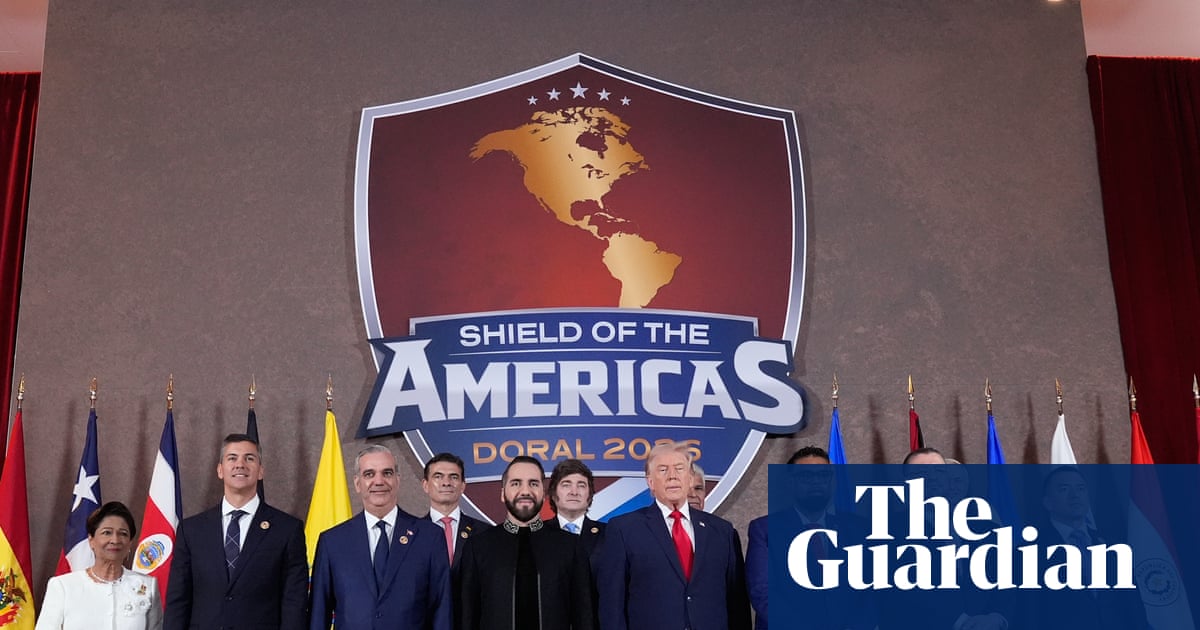
Trump Hosts ‘Shield of the Americas’ Summit with Latin American Leaders liberal Liberal outlets depict the Shield of the Americas summit as a bid to reassert U.S. dominance in Latin America under a revamped Monroe Doctrine, prioritizing military action against cartels and pressure to counter China over nuanced, civilian-led solutions. They emphasize the risks of regional militarization, partners’ economic dependence on China, and the way migration and security rhetoric serves Trump’s domestic political agenda. @CBS News @The Gateway Pundit @The Guardian
conservative Conservative outlets portray the summit as a landmark effort to build a counter-cartel coalition, demonstrating Trump’s renewed focus on the Western Hemisphere and commitment to allies willing to confront shared threats. They frame robust military cooperation, tighter migration control, and resistance to Chinese influence as necessary steps to restore regional security, sovereignty, and stability. @The Washington Times @The Epoch Times @Washington Examiner @Infowars President Donald Trump hosted the inaugural “Shield of the Americas” summit at his Florida golf properties, described variously as Trump National Doral or Mar-a-Lago in the Miami area, bringing together leaders or senior representatives from about 12 Latin American and Caribbean countries. Across outlets, coverage agrees that the core goals were to form a new Americas Counter Cartel Coalition, coordinate joint military and security operations against violent drug cartels (some designated as foreign terrorist organizations), and address related regional issues like illegal migration and foreign—especially Chinese—economic and political influence. Both sides note Trump’s calls for participating governments to commit more robust military force against cartels, his warning that the United States would act unilaterally if partners did not do enough, and the prominent role of U.S. figures such as Kristi Noem, who was introduced as a special envoy focused on migration control. Reports also agree that, even as the administration faces multiple global crises, this summit was framed as a high‑profile signal of renewed attention to the Western Hemisphere and U.S. security interests close to home.
Coverage from both liberal and conservative sources situates the summit within a broader historical and geopolitical frame, referencing the Monroe Doctrine and Trump’s so‑called “Donroe Doctrine” or “Trump Corollary” as shorthand for reasserting U.S. primacy in the hemisphere and resisting extra‑regional powers’ control of strategic assets. Outlets agree that China’s expanding investment and trade footprint in Latin America is a central concern, that many regional economies remain deeply intertwined with Chinese financing and markets, and that this creates tension for leaders asked to align more closely with Washington’s agenda. They also converge on the context of persistent cartel‑driven violence, cross‑border drug flows, and migration pressures that have strained U.S. domestic politics and bilateral relations, especially with Mexico. Both perspectives note that not all major regional powers were present and that some leaders are wary of being drawn too tightly into a U.S.‑led security architecture, even as they share an interest in curbing organized crime and stabilizing their own societies.
Areas of disagreement
Motives and framing of U.S. power. Liberal‑aligned outlets tend to cast the summit as an effort to resurrect a more overtly hegemonic U.S. role in Latin America, highlighting rhetoric about a Trump Corollary to the Monroe Doctrine and warning that “America First” foreign policy risks subordinating regional partners’ sovereignty. Conservative outlets, by contrast, frame the same doctrines as overdue clarity about hemispheric defense, portraying the summit as a good‑faith coalition of “like‑minded allies” facing common threats rather than a vehicle for domination. Liberals emphasize the asymmetry of power and the risk that security cooperation becomes a cover for U.S. militarization, while conservatives emphasize partnership, shared values, and Washington’s responsibility to lead.
Military action and security strategy. Liberal coverage is more skeptical of Trump’s emphasis on military solutions, underlining the talk of missiles, expanded joint operations on Latin American soil, and designating cartels as terrorist organizations as potentially escalating violence and undermining civilian governance. Conservative sources depict the same measures as necessary toughness after years of failed, softer approaches, stressing that cartels operate as de facto insurgent armies and therefore warrant military‑grade responses. While liberals question whether militarization addresses root causes like corruption, inequality, and demand for drugs, conservatives largely present those concerns as secondary to restoring order and deterrence.
China, economics, and foreign influence. Liberal outlets highlight regional leaders’ reluctance to sever or significantly downgrade economic ties with China, stressing the material dependence on Chinese trade and investment and framing Trump’s push as forcing countries into a risky geopolitical choice. Conservative coverage generally portrays China’s role as a clear strategic threat that enables corruption, undermines sovereignty, and could control critical infrastructure, and thus treats efforts to counter Beijing as both urgent and widely welcomed by responsible partners. Liberals emphasize the costs and constraints Latin American governments face if they pivot too sharply away from China, while conservatives focus on the long‑term security payoff of aligning more firmly with the United States.
Migration and domestic politics. Liberal‑leaning reporting tends to portray the summit’s strong focus on migration control as intertwined with Trump’s domestic political agenda, suggesting that the rhetoric is crafted to appeal to U.S. voters more than to build balanced regional solutions. Conservative outlets, by comparison, present migration control as a shared economic and security imperative, echoing Kristi Noem’s arguments that limiting irregular flows is essential for prosperity and sovereignty on both sides of the border. Liberals are more likely to stress the humanitarian dimensions and structural drivers of migration, whereas conservatives foreground border security, law enforcement, and the need for partner governments to crack down on smuggling networks.
In summary, liberal coverage tends to stress U.S. hegemonic ambitions, risks of militarization, and the economic and political constraints facing Latin American partners, while conservative coverage tends to celebrate decisive security cooperation, frame U.S. leadership as protective rather than domineering, and highlight the summit as a long‑overdue assertion of hemispheric resolve. Story coverage
Write a comment