How Nostr Wins

- Creators Need To Get Paid
- The $1 Barrier of Legacy Social
- The Lost Legacy Revenue
- Nostr: The Missing Slice of the Distribution
- All We Need Are Eyeballs
“Why hasn’t Nostr taken off yet?” is a perennial question in the ecosystem
We have a system of decentralized, censorship-resistant social media. Just about anything in the current social media world can be reproduced in some form via the distinct “kinds” of Nostr notes. Kind 1 microblogging a la Twitter, Facebook, and Mastodon. Long-form articles like Substack. Now, short-form looping videos via Divine, secure messaging with Marmot, and an ever-increasing multitude of “Other Stuff.”
And yet, frustrated developers seem to be constantly asking, “why hasn’t this taken the world by storm yet?”
Some of this just requires patience. As commenters like Cory Doctorow have extensively documented, legacy social media is dying a long, slow self-inflicted death due enshittification. The inevitable cycle of capitalistic growth, consolidation, platform decay, and upstart disruption is currently playing out and will continue for the foreseeable future.
But what makes us think we will succeed? It’s one word, “zap”, that fundamentally disrupts the existing social media paradigm, centralized or decentralized. And here’s why.
Creators Need To Get Paid
Forget about social media for a minute; throughout history, whether you write, paint pictures, or dance and sing for the amusement of others – you need to find a way to turn that into a means of survival. Social media doesn’t change this, but it does allow for vastly increased models of monetization.
Previously, if you wanted to profit from creative activity you needed to sign on to some kind of large syndication model. Writers needed to get their articles or books published in newspapers, magazines, or by presses. Now they can go direct to Substack and other routes. Similarly, actors or other on-camera talent had to sign on with TV networks, movie studies, etc, but now have YouTube.
This has led to the much celebrated long-tail democratization of content creation that the internet has enabled, and for good reason. Thousands, perhaps even millions of people can now make some kind of living creating content for the internet who would never have been able to in the 20th century or earlier.
The $1 Barrier of Legacy Social
In Bitcoin we talk about the “dust” limit as a practical lower limit of the amount of Bitcoin that can be transacted on the network. If transaction fees are greater than the amount transacted, it doesn’t make economic sense to send the transaction. Lightning gets around this by bundling many transactions into one, allowing for micro-transactions down to a single Satoshi. While the community often jokes about a ‘21 sat’ minimum, the protocol imposes no such floor.
However, in just about all legacy platforms, one frequently encounters a $1 floor for transactions. X’s tip jar won’t allow less than $1, Patreon subscription tiers bottom out at $1, etc. This is enforced by the logic of the payment processor, usually Visa or Mastercard, that can’t economically process transactions below this threshold.
In addition, it should be noted that any legacy social media monetization requires participation in OFAC-compliant financial systems, which necessarily exclude perhaps billions of people on the planet.
But we’re just talking about $1…. why should that matter?
The Lost Legacy Revenue
Let’s imagine now the distribution of the number of people willing to pay a variable amount, $x, for your content. That graph is probably going to follow a power law, something like this:
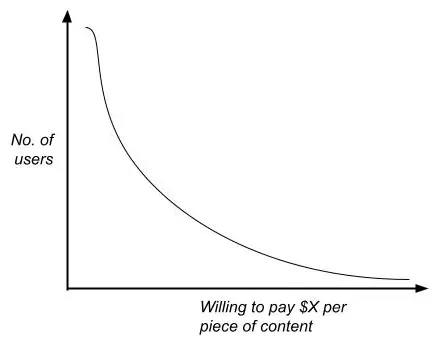
There’s a large number of people willing to toss you a few cents for providing them with a wry chuckle or whatever, and a much fewer number of people willing to donate $5 because they’re amazed by what you made.
But here’s the rub: Now there’s a “dead zone” where you can’t make revenue:
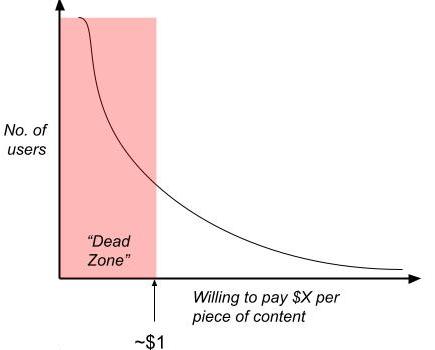
And here’s our $1 threshold. You’re missing out on the entire “fat tail” of the distribution who might be willing to pay less than $1, aren’t plugged into the Western financial system, or both. That’s a massive global audience who might be able to consume your content, but absolutely can’t support you financially, even if they might want to do so.
This effect has another consequence, which is a turn-on threshold for monetization:
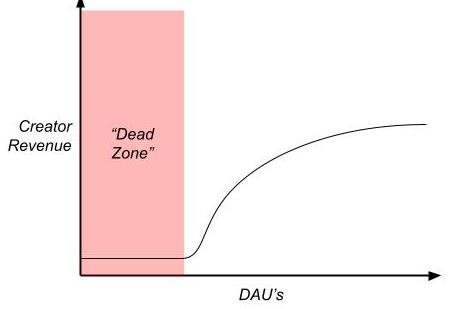
To monetize your content in the legacy systems you need at least 1 viewer (parameterized by daily active users or DAU’s here) willing to pay $1 for your content. That means, you have a minimum audience size. It’s simple math: If only (say) 0.1% of the total audience of the platform is willing to pay $1 for your thing, your reach needs to be at least 1000 before you see dollar 1. Ideally, you need a reach of 100k if you want to make $100.
So in the legacy system, you need to aggressively promote yourself to grab the necessary audience, with 0 revenue the entire time, before you see your first $1 of revenue.
The distribution also levels out at a certain point: This depends on whether your content has some kind of “mass appeal”, but at a certain point you will hit market saturation, meaning you’ve already captured everyone willing to pay >$1 through the existing monetization means. At that point, you’re either happy with what you’ve got, or you must pivot to mass-market media (linear TV, film deals, boxing Mike Tyson, etc) to capture the remaining value.
Nostr: The Missing Slice of the Distribution
Now, enter Nostr with Zaps. No more dead zone:
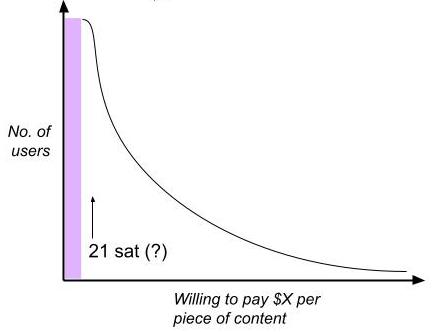
Now your minimum donation is 1 Satoshi, effectively $0… From sub-penny amounts, to a King’s ransom, all in a “zap”, from literally anywhere on Earth.
Now what’s really interesting here is that the revenue function with DAU’s is fundamentally altered:
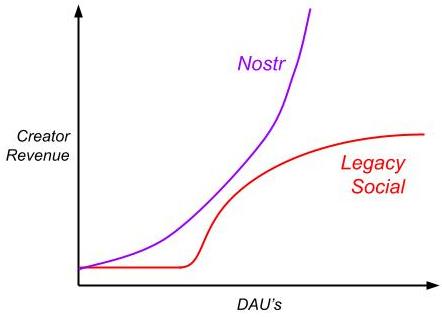
First, on the low-DAU side, revenue starts immediately. Basically, anyone can zap any amount. So you start earning early, learning what works and what doesn’t for your audience, as you grow. No more having to “infer” from page views, impressions, Spotify plays, or whatever opaque parameters the legacy platforms give you.
Second, an interesting thing happens on the high-DAU side as well. In the legacy system, “long-tail” effects saturate, and thus once the initial low-value donors are captured, creator revenue only rises linearly. In other words, you’ve already found everyone willing to pay ~$1-10 dollars for your content, and now you’re just chasing the whales at the long end of the distribution (hence, why social media creators still wind up signing record deals, doing TV deals, etc).
On the other hand, in the Nostr model, revenue keeps increasing. Because more DAU’s means you’re continuously adding onto the short tail of the distribution, which expands much faster than the long tail.
Of course, there will be some saturation at some point – but what this limit will be isn’t clear. It won’t have the legacy social limits of (a) the $1 threshold, (b) the need to be able to participate in OFAC-compliant payment systems, and (c) the platform’s corporate blessing.
All We Need Are Eyeballs
First the reality check: By most metrics Nostr is somewhere in the range of ~5,000 DAU’s. This is not enough to support sufficient monetization, for the reasons I’ve outlined – at ~0.1% conversion rate, you have only about ~5 people willing to pay for your content at best.
Now, the good news. Once this takes off, there’s no stopping it. The monetization potential is practically unlimited, or at least unprecedented in the history of social media. While legacy social media systems have indeed reached a significant portion of humanity – billions of users – the monetization of this content has been much less complete.
An unbanked teenager in Tunisia can dance their heart out on TikTok – they’ll never see the same revenue, if any at all, as if they were dancing in Toledo. Nostr + lightning levels this playing field, and finally offers the true promise of the global democratization of content creation.
I don’t know what the “magic number” is – probably closer to 100K DAUs – but once we get there, we will inevitably see every content creator on the internet move to Nostr. Not because they care about decentralization, or Bitcoin, or anything; because it will be the best, and eventually only, way to make money on the internet from producing content.
@3f770...45b24 inspired by discussion earlier today
Highlights (1)
An unbanked teenager in Tunisia can dance their heart out on TikTok -- they'll never see the same revenue, if any at all, as if they were dancing in Toledo. Nostr + lightning levels this playing field, and finally offers the true promise of the global democratization of content creation.
Write a comment